

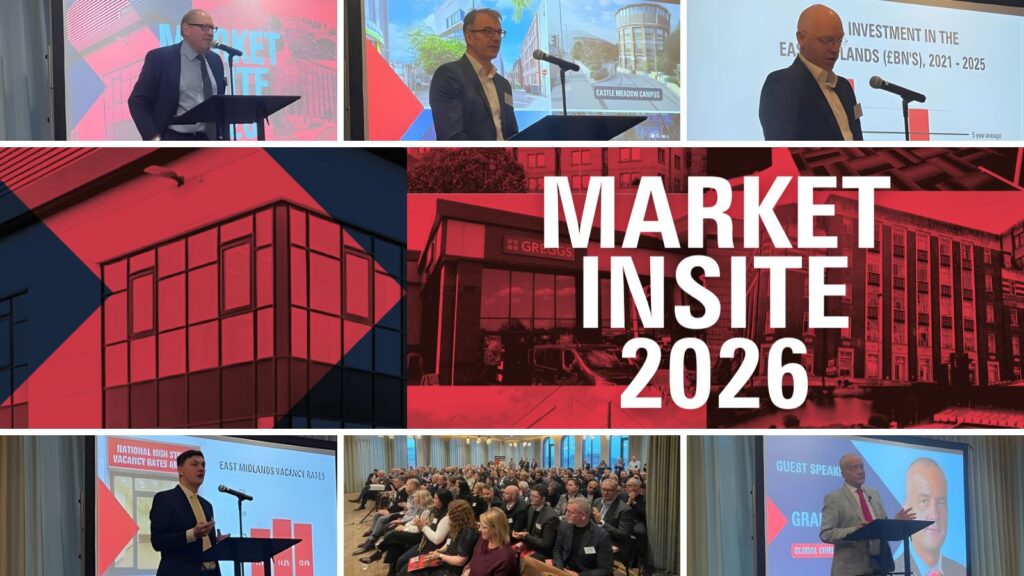
A NEW commercial property report highlights the East Midlands’ resilience amid a significant drop in investment volumes, with increased levels of take-up in some key sectors last year.
Total investment volumes in 2025 were just under £1.2 billion – in stark contrast to our Market Insite report last year revealing that commercial property investment had broken through the £2 billion mark in 2024, outperforming the national picture.
Overall, prime yields remained stable across all main sectors throughout last year. Office investment activity gained slightly to end the year at just over £88m, while the living sector continued to perform well, up by nearly 60%. However, our Market Insite 2026 report shows that Nottingham, Leicester and Derby all suffered a drop in industrial investment activity, to just under £600m, partly through limited stock availability.
Head of investment Ben Robinson told an audience of industry professionals at the report’s launch that the industrials sector typically dominates the market but had dropped from 75% of all activity the previous year to a little below 50% in 2025.
Ben explained: “We believe the pullback in activity, which was seen across the board of all three East Midlands cities, was largely down to a combination of a lack of available stock and the previous year’s out-performance, as investor appetite and sector fundamentals remain strong.”
The report was unveiled at Nottingham event space Cleaver & Wake on Tuesday 3 February, where speaker and leading economist Graeme Leach observed that amid “some of the most challenging conditions in recent memory”, organisations must “position themselves for long-term resilience rather than short-term reaction”. Other highlights from the Market Insite report included:
· The living sector recorded £243m of investment transactions – a near 60% increase – driven by investor activity in Derby and particularly Leicester
· Derby’s offices sector saw the highest level of take-up for 12 years, including 81% in Grade B
· Nottingham’s offices had a 30% uplift, rising to 363,700 sq ft in 2025, while take-up of grade A city centre stock increased by 190%
· Rents grew by 45% for prime Grade A and 38% for Grade B over a five-year period in Leicester’s industrial sector, with Derby also experiencing significant rental growth
· Nottingham’s industrial sector had the highest take-up, of 1.16m sq ft, since 2014
· Derby’s industrial take-up remained above the 10-year average for the fifth consecutive year in 2025
· The retail and roadside sector saw continued growth in city centre bars and restaurants and a rise in convenience retailing plus drive-to and drive-thru destinations
Ben added: “We expect investor appetite to return to the office sector as the resilient occupier market, relatively tight supply and attractive entry yields make a compelling investment case, as we are starting to see playing out across the UK’s ‘Big Six’ cities.”
Guest speaker Graeme Leach, CEO of Macronomics Consulting, offered his guidance at the event. He warned of dangers in the UK’s outlook, cautioning that political risk could prove a ‘canary in the coal mine’. By way of illustrating the market trepidation, Graeme noted that 10-year gilt rates were higher now than they had been even in the Truss-Kwarteng period. Thankfully, he said, three ‘shock absorbers’ may have a protective effect upon the UK economy in 2026: deeper rate cuts, an acceleration in quantitative easing, and slack in the household savings ratio. Graeme added: “Amid ongoing uncertainty in the British economic outlook, organisations are facing some of the most challenging conditions in recent memory. “In times like these, it is more important than ever to get ahead – by planning proactively, investing wisely and positioning for long-term resilience rather than short-term reaction.” Some of the biggest deals of last year in different sectors and each city feature in the Market Insite report, including:
Offices:
· Nottingham: The largest deal of the year was the 31,170 sq ft letting to Arden University at Castle Meadow Campus; while See Tickets took 19,362 sq ft at The Hockley Pod on Fletcher Gate
· Leicester: A growing trend in the city centre is the repurposing of older office buildings, the largest in 2025 being the sale of Arnhem House, totalling 64,021 sq ft
· Derby: The largest transaction was the 29,300 sq ft disposal of St James House, Mansfield Road, to Derby City Council, while MHA acquired 23,000 sq ft at Wyvern Business Park
Industrial:
· Nottingham: The most significant transaction was the 145,723 sq ft letting of Power 146 on Thane Road to BDM Logistics, while Swedish engineering group ABB took 100,000 sq ft at Fairham Business Park
· Leicester: Two ‘big box’ deals completed – the 491,926 sq ft pre-let to Tesco at Mountpark, Hinckley, and the 277,260 sq ft letting of Optimus 277 at Junction 21A of the M1 to Accrol Group
· Derby: The largest transaction was the 195,000 sq ft build-to-suit facility at Infinity Park; a second big box deal was the 120,000 sq ft pre-let at SEGRO’s SmartParc Derby
While the UK’s retail and roadside market largely struggled in 2025, several notable East Midlands deals highlighted that the right locations will always work, said sector specialist and associate director Sam Hall.
Sam said: “Cities with strong, established shopping centres, such as Derby and Leicester, have seen retailers relocating from prime high streets into the centres. This follows consumer trends of prioritising convenience and experience when they can park, be entertained, shop and eat all in one place.”
But he warned that rising costs, such as increases to the National Living Wage, are becoming increasingly difficult for businesses to absorb. The higher multiplier for properties with a rateable value above £500,000 had also done little to soften the blow to the major retailers, Sam added.
“These larger format stores currently pay a third of the industry’s business rates bill and employ over a million people. Many of these stores act as major anchors for retail parks and shopping centres, meaning any closures could have a substantial impact on the retail landscape.”
In other sector changes, Sam pointed out:
· A “competitive and fierce” market for value-for-money retailers with increased demand due to the cost of living crisis
· New formats, such as Co-op’s ‘On the Go’ micro stores, are being launched in response to changing consumer spending habits
· Food retail giant Greggs is reaching new locations in retail parks and transport hubs with its ‘Bitesize’ concept
We organised three further Market Insite events in Leicester, Birmingham and Derby. Managing director Matt Hannah said: “Reviewing the data is always fascinating and we enjoy our in-person events to explain the thinking behind the numbers.
“Data is everything in today’s business environment. Our Market Insite research reflects how the region and the commercial property market are responding to shifting economic conditions, changing occupier behaviour and investor priorities.”
To read the full East Midlands investment breakdown, download our Market Insite 2026 report here: https://innes-england.com/market-insite-2026/